Structure data from external sources
The FIS relies on some structure data that originate and are maintained elsewhere/by other systems. The data is used for reference purposes and to ensure consistency.
We call the process of getting this data into the FIS database synchronisation. And we split this in two steps: fetching and updates. The diagram below shows a conceptual overview of the synchronisation process.

The left target table is the target of the synchronisation process. It is the table whose data will be used by the rest of the system as a trusted source of information. The right staging table represents a kind of intermediary step, splitting the fetching and update steps.
Fetching is the process of getting data from the external source and loading it into a staging table. The updates functionality is responsible for comparing existing data with the staging table and updating the target table accordingly.
The structure data that must be synchronised is summarised in the table below.
| Data | Description/comment | Size in records (NO) | Authority (NO) | Update |
|---|---|---|---|---|
| Party | Market participants (SP, BRP, ES and SO) | ~500 | Ediel | Notice |
| Price Area | NO1-5 in Norway | ~5 | Statnett | Automatic |
| Metering Grid Area (MGA) | Grid areas used in settlement, including SO and price area relation | ~500 | Statnett | Automatic |
| Energy Supplier Balance Responsibility | Balance responsibility of each ES, MGA and direction | ~100k | eSett | Automatic |
| Grid Model | Substations, clusters, and lines, to locate accounting points | ~8200 | Elbits Nemo | Automatic |
As you can see from the last column in the table, there are two different strategies for doing updates: notice and automatic. These will be described in more detail below, but let's first look at the general pattern.
Fetching mechanism
This data must be fetched and loaded by a component that is external to the FIS itself. The reason for keeping this responsibility outside of the FIS is that depending on what country/context the system is deployed in, the data may be sourced from different places. Baking the data loading process into the FIS would tie the system to a specific set of data sources, which is not desirable.
Data is loaded into the staging structure with business identifiers from the external data source. It is the responsibility of the fetching component and staging structure to ensure that the data is of the right format and quality.
Getting data
When synchronising data, in general, we can distinguish between three different technical approaches:
full- The whole dataset is fetched and compared to the existing data.delta- Changes since the last synchronisation are fetched and applied to the existing data.event-based- Changes are sent as they happen, and the existing data is updated accordingly.
In addition to this, the full and delta approaches can be either scheduled
or triggered ad-hoc by users.
The FIS synchronisations only currently use the full approach, based on a
scheduled external mechanism. Other approaches will be added on an as-needed
basis.
All these structure data types are slow-moving, meaning that they do not change very often. Synchronising the data can be done on a nightly basis, and it is not critical if the data is a few hours or even a day or two old.
Interdependencies among our resources (such as foreign key constraints) also make bulk updates impossible to run without extra care to avoid introducing too many inconsistencies.
Database interface
The data fetching component interfaces directly with the database to load the
data into the staging structure. We do this via dedicated procedures and
unlogged tables in a separate staging schema. This is to ensure decoupling and
prevent assuming an internal database structure from the outside, which makes us
free to change the internal details over time if needed.
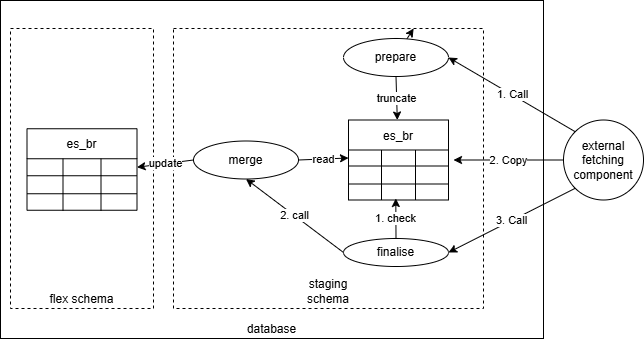
Data loading is done in four steps into an unlogged table in the staging schema:
- Call a
prepareprocedure that generally just truncates the staging table. - Load the data into the staging table. This is done via a bulk loading mechanism
(e.g.
COPYin Postgres). - Call a
finaliseprocedure that does some crude safety checks and then callsupdatewhich merges the data into the target table.
Update mechanism
We have two different mechanisms for doing updates into the target tables in the system: notice and automatic. We are picking the mechanism based on the size and significance of the data.
Automatic
For data that is "big" and/or frequently updated, we cannot rely on manual review and acceptance. We accept all updates and need to bake in safety logic to ensure that we do not accept bad data/updates. The energy supplier balance responsibility data is loaded with this strategy. The diagram below shows how this is done in the system.
Notice
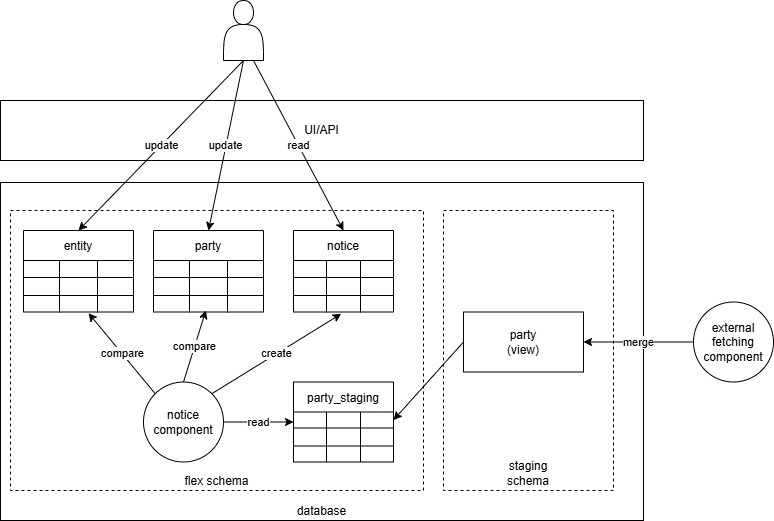
For data that is not too big and whose updates are not too frequent, we rely on a FIS operator to review the data and decide whether to accept it or not. The operator is mostly in the loop to be informed, but can also do/request changes to the data in upstream systems in case something is wrong.
The operator is made aware of the updates via
notices. This mechanism adds an
additional _staging table in the flex schema to facilitate the notice
generation.
For instance, party synchronisation is done manually by the appropriate users, after they have received notices about the inconsistency or out-of-sync state to review and resolve, whereas balance responsibility is to be loaded automatically every day by a background process. The diagram below shows how the party synchronisation process works in the system.